Basketball balls: indoor and playground
Size 5, 6 or 7, composite leather or rubber, FFBB or FIBA approval, well-regulated pressure: four criteria are enough to choose from the basketballs. The size depends on your category, the material on your court, and the approval for your level of play.
Search by surface, by brand or by your team's colours, then filter by size.


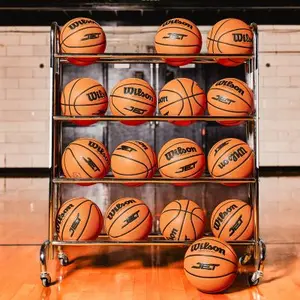

Size 5, 6, or 7: the size category
The right ball size depends on your age group and gender, not your hand size. The rules of the FFBB align with three formats.
- Size 5, around 70 cm in circumference: mini-basket, up to U11 inclusive.
- Size 6, around 74 cm in circumference and between 510 and 567 grams: all U13 players, followed by girls and women at all levels.
- Size 7, around 78 cm in circumference and between 567 and 650 grams: boys from U15 and above, then men.
The smallest often start with a size 3, which is lighter and fits in the hands of four or five-year-olds. A ball that is too big for their age encourages the child to throw with their shoulders instead of their wrists, which affects their shooting motion.
Composite leather or rubber: what the outer cover says
The outer cover determines where the ball can be used. Composite leather, a synthetic microfiber, absorbs sweat and provides the finest touch indoors, but concrete wears it down after a few outings. Rubber withstands asphalt, dust, and moisture, at the cost of a harder feel. Between the two, reinforced synthetic balls can transition from gym to outdoor court without too much wear.
Under the cover, a butyl bladder retains air, and a nylon winding keeps the round shape. It's this winding that gives a consistent bounce from one dribble to another.
FFBB and FIBA approval: when it matters
It matters for official matches. A ball approved by the FFBB has been validated for French championships, and the FIBA Approved label ensures compliance with international standards for weight, circumference, and bounce. For home training or playground use, approval doesn't add any extra benefits: choose based on the surface and your budget.
If you play in a club, ask your coach which model is used in matches. Training with the same ball helps you build shooting consistency.
Inflation and pressure: the bounce test
A well-inflated ball, dropped from about 1.80 m measured from the base of the ball, should bounce back between 1.20 m and 1.40 m measured at the top of the ball. This is the FIBA regulation test, and you can redo it in your garage. Most manufacturers recommend a pressure between 0.49 and 0.63 bar, often printed near the valve.
Moisten the needle before inserting it into the valve, and never inflate beyond the indicated value: a ball that's too hard deforms and bounces unevenly. A pump and spare needles can be found with ball bags in the ball accessories.
Where to start: surface, brand, team colours
Three entry points lead to the right ball, depending on what you already know.
If you know where you'll be playing, the balls by surface page separates indoor, outdoor, and all-purpose models. If you have a brand in mind, the balls by brand page lists them one by one. For a fan, the team colour balls feature the franchises' logos in supporter versions. And for everything related to the ball, pumps, needles, and carrying bags are gathered in the accessories.
Molten, Wilson, Spalding: who does what
Each major ball brand has its area of expertise.
- Molten supplies the balls for FIBA competitions, including the World Cup and Olympic tournament. Its Compet balls approved by FFBB are used in many club matches, and its BG range covers training.
- Wilson makes the official NBA ball and the ball for the FIBA 3x3 circuit. Its Evolution is the star indoor ball in American high schools.
- Spalding was the NBA ball for decades. Its TF range goes from the TF-50 in rubber to the TF-1000 for indoor play.
- Nike focuses on outdoor with the Everyday Playground and offers street balls named after Kobe Bryant and LeBron James.
- Baden Sports, an American brand, provides the ball for the German league and models for all surfaces.
How to pay less for your next ball
Discounts can be found on dedicated pages. The special ball offers showcase current promotions, and the new ball arrivals highlight recently added models. For a ball that sells quickly, the balls shipped in 24h are in stock. Throughout the year, you’ll find the Black Friday balls, the selection of Christmas balls for gifts, and then the ball sales. End-of-line products from the entire site are available at clearing sales.
Frequently asked questions
How long does a basketball last?
It all depends on the surface and frequency of use. A composite used indoors two or three times a week will maintain its grip for several seasons, whereas the same ball on concrete will wear smooth in a few weeks. Replace it when the outer cover becomes slippery, it loses air day by day, or it bounces unevenly.
Do you need a personal ball when playing in a club?
It's not required, the club provides the training and match balls. Having your own ball helps you work on your dribble and shooting between training sessions. Get one in the size of your category, and if possible, the same type as the club's.
Can you inflate a basketball with a bicycle pump?
Yes, as long as you use a suitable inflation needle on the nozzle. Wet the needle before inserting it to avoid damaging the valve. Inflate in small bursts and check with the bounce test, as a bike pump delivers a lot of air at once.
How should you store your ball to make it last?
Store it away from heat and sunlight, never against a radiator or in a trunk during summer. Don't sit on it, as it deforms the bladder. A ball stored for a long time may remain slightly under-inflated, but can be re-inflated before playing.
Can a basketball be used for 3x3?
For playing among friends, yes. In official competition, the 3x3 uses a specific ball: the circumference of a size 6 for the weight of a size 7. It handles like a small ball but retains the inertia of a large one, which changes the feeling of shooting.